
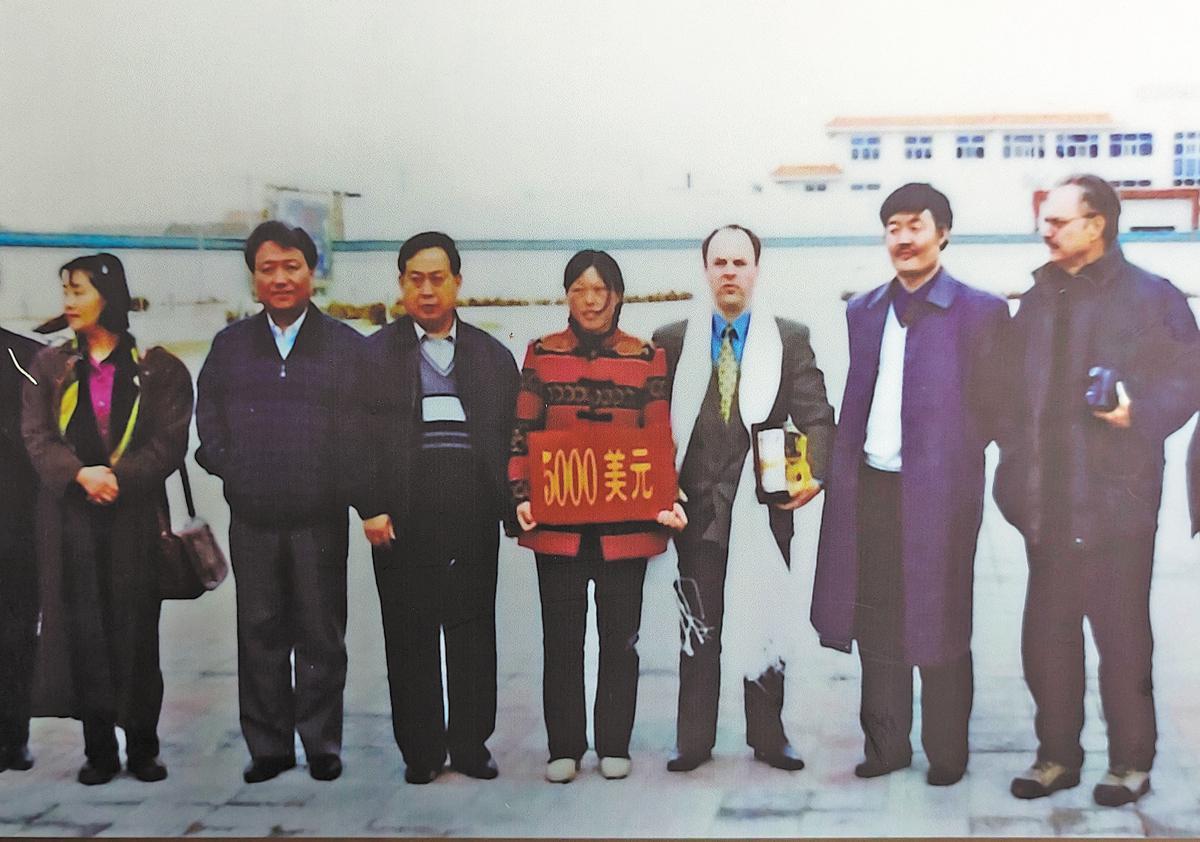
United States history teacher Ronald Sakolsky (third from right) poses with Yin Yuzhen (center), a national model worker in Maowusu, China’s fourth-largest sandy area, in the spring of 2000, when Sakolsky raised $5,000 to help Yin and her husband plant trees and fight desertification. [Photo/Xinhua]
A voice from afar spoke through the cellphone in the hands of 60-year-old Yin Yuzhen in the Inner Mongolia autonomous region: "It's amazing! It's amazing to me! I can't believe we are talking."
The voice belonged to Ronald Sakolsky, 69, a retired high school teacher in the United States.
Yin asked: "When will you return to China to see the green forest that has grown from the $5,000 you contributed years ago?"
It had been decades since they last spoke, but like many such conversations between friends, it seemed perfectly natural to be picking up where they had left off. "I will be waiting for you in the desert," she added.
A video of their interaction, which was recently released online by a local media group, has touched the hearts of millions across China.
Yin, a resident of Wushen Banner in the city of Ordos, is a national model worker widely acclaimed as one of China's afforestation heroes. Starting in the mid-1980s, she spent four decades reversing desertification and greening a stretch of Maowusu, the fourth-largest sandy area in China, by planting trees.
Yin had long been searching for her "American friend" who raised money to support her afforestation work.
Earlier this month, Yin sought the help of local media to find him. In an online video post on May 16, she said, "Sakolsky, if you see this, I would like to invite you to come back to China, where your $5,000 has grown into a large forest."
Netizens, including Sakolsky's former students and colleagues, responded, which resulted in their brief phone reunion on May 18.
As part of a teacher exchange program, Sakolsky taught English at a school in Luoyang, Henan province, from 1999 to 2000. During that time, he saw a television program about Yin's sand control work and was moved by her unyielding spirit.
Hoping to fund her afforestation efforts, Sakolsky wrote to many institutions in the US. An institution in Boston, Massachusetts, agreed to donate $5,000 for Yin's work. The money was sent to her in cash through a Chinese organization.
In 2000, Sakolsky traveled to Maowusu to meet Yin in person. What he saw was inspiring. Yin was planting trees in the desert using just a shovel and traditional shoulder poles. She tied young saplings, which were as thin as fingers, with hemp rope and carried them in bundles to be planted on the uneven ground.
Between 1985 and 1999, Yin and her husband planted saplings across nearly 2,667 hectares.
"When Sakolsky came, he kept repeating the word 'impossible'," she recalled in the video post. "Well, I made 'impossible' possible. At that time, I had never seen so much money."
Yin spent most of the money on buying saplings, but kept $1 as a souvenir. When Sakolsky left China after completing his teaching assignment in Luoyang, the two lost touch.
Over the years, Yin stayed in Maowusu, planting trees each day. Her persistent work earned her recognition as a national model worker and national hero of desert prevention and control. In 2017, she shared her experience at the United Nations Convention to Combat Desertification.
Maowusu covers about 42,200 square kilometers. Two-thirds of it is located in Ordos, and the rest extends to Shaanxi province and the Ningxia Hui autonomous region.
With the Great Wall lying in the south, the sandy land has long resisted reclamation. Through the efforts made by Yin and others, more than 559,000 hectares are now blanketed in green, and the forest coverage rate is about 33 percent.
Speaking to China Daily on Sunday, Sakolsky was full of praise for Yin. "She is committed to her dream. She never gave up."
He told People's Daily: "The outreach effort of my former students and colleagues in China was impressive. It really is a miracle to get back in touch."
Mutual respect goes beyond borders. Yin told China News Service that Sakolsky helped her buy saplings "at the most difficult time", and that she has "never forgotten and will never forget" his kindness.
The real miracle is bigger than their reunion; it is seeing young saplings grow into dense forests.
Foreign Ministry spokeswoman Mao Ning said on Monday that the friendship between Yin and Sakolsky is a microcosm of the positive people-to-people exchanges between China and the US.
"We are confident that the two peoples will keep adding new chapters of friendship and injecting fresh vitality into bilateral ties," Mao said.
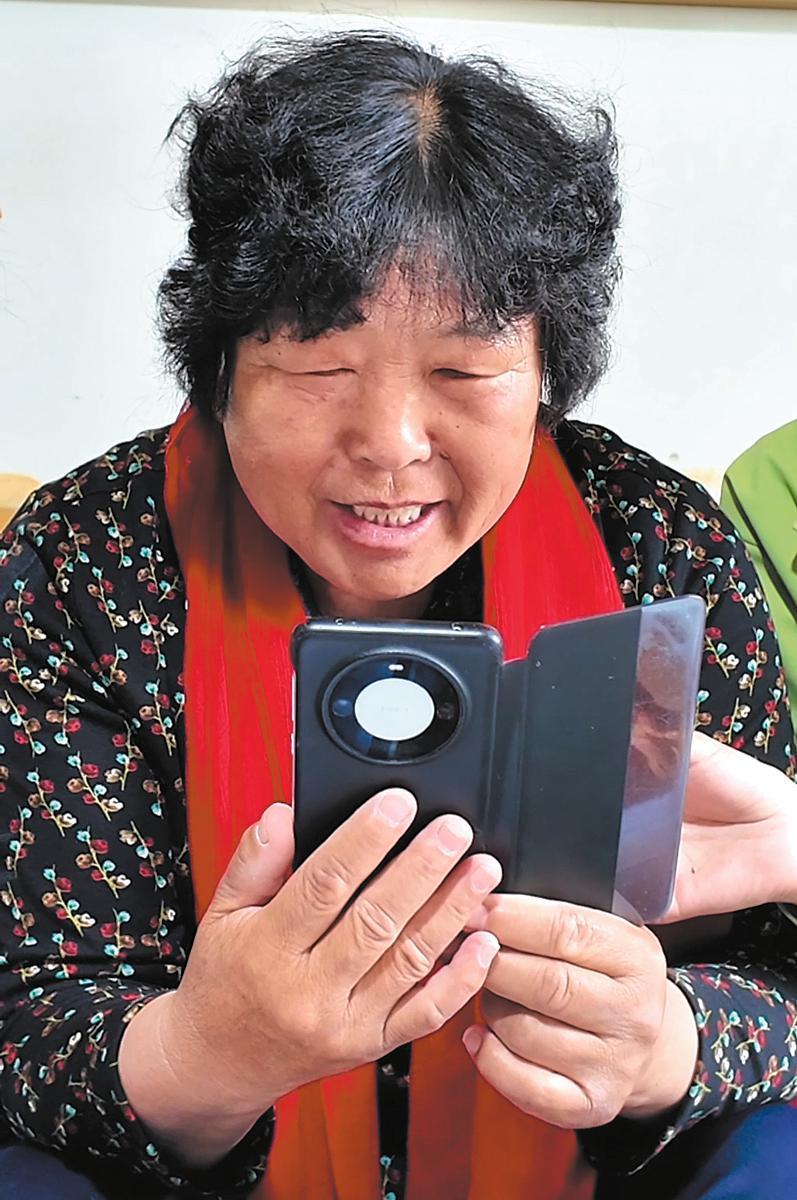
Yin speaks with Sakolsky by phone on May 18. [Photo/Xinhua]
521人浏览
2730人浏览
1547人浏览
2209人浏览
431人浏览
373人浏览
语言培训是留学准备链条中可规划性较强的环节。语言成绩作为申请材料的基础门槛,直接影响院校选择范围与申请竞争力。不同考试在题型结构、评分标准与院校认可度上存在差异,选择适合自身的考试并制定科学的备考计划
在申请韩国留学签证时,除了提供学术背景、语言能力等必要的材料外,申请人还需要证明自己具备足够的财力拥护在韩国的学习和生活费用。韩国留学签证的财力证明要求主要是为了确保申请人不会在留学期间遇到经济艰难。
深耕美国留学规划多年,很多家长和学生在规划留学背景提升时,都会考虑参加美国大学的暑期学校。夏校不仅能够让学生提前体验美国大学的学术环境与校园生活,还能在申请中展现学术能力与国际视野,是背景提升的重要途
在申请加拿大的博士项目时,申请人需要知道并准备一系列条件和步骤。加拿大的教育系统在全球范围内享有盛誉,吸引了大量国际学生前来深造。对于那些期望攻读博士学位的学生来说,知道加拿大博士申请的条件和流
中新网永州10月22日电 (杨苗珊)在今年9月湖南省第十五届运动会青少年组赛艇赛事中,湖南冷水滩少年唐烁斩获 U18男子轻量级2000米陆上赛艇金牌。从田径跑道转战赛艇航道,15岁被教练发掘,到站上省
在申请韩国留学签证时,除了提供学术背景、语言能力等必要的材料外,申请人还需要证明自己具备足够的财力拥护在韩国的学习和生活费用。韩国留学签证的财力证明要求主要是为了确保申请人不会在留学期间遇到经济艰难。

